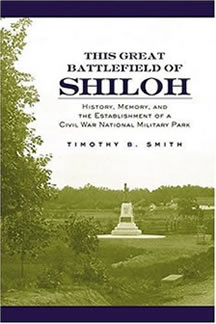
this great battlefield of shiloh: history, memory, and
the establishment of a civil war national military park. by timothy
b. smith. (knoxville: university of tennessee press, 2004.)
how
the history of
a battle is created and retold is not always determined by the
conflict’s principal participants,
but instead by lesser-known individuals who were instrumental
in the preservation and creation of our national military parks.
the story of the creation of these parks also tells us much about
the importance of these places in
american memory. both of these points are made clear in timothy
b. smith’s well-crafted this great battlefield of shiloh,
history, memory, and the establishment of a civil war national
military park.
u. s. grant, albert sidney johnston, william t. sherman, and p.
g. t. beauregard are a few of the many famous personalities who
are
instantly associated with that landmark april 1862 battle. yet
it was not these men, but lower-ranking veterans and others
-- such as david w. reed, cornelius cadle, and atwell thompson
-- who, over thirty years later, not only created shiloh national
military
park, but also much of the longstanding, accepted history of the
battle.
while providing a brief overview of the shiloh area, along with
a short summary of the campaign and battle, the book obviously
concentrates on the establishment and history of the park itself:
specifically from the park’s creation by congress in 1893
through the transfer of control to the national park service in
1933.
using the same system employed in the creation of other national
military parks at that time (chickamauga, vicksburg, and gettysburg),
congress mandated that the war department create a shiloh commission
to oversee the design, construction, and eventual
operation of the park. these commissions usually consisted of
three park commissioners: two union and one confederate veteran
of the
battle,
along with
their support
staff. the three most central and influential
figures of the shiloh commission were reed (secretary and historian),
cadle (commission chairman), and thompson (chief engineer).
smith’s narrative details the numerous obstacles these three
men overcame, including: 1) the gaining of congressional legislation,
2) the constant struggle for funding and the subsequent undersized
workforce, 3) the mechanics of creating the park’s
physical infrastructure (surveying the field, acquiring the land,
building
avenues, bridges, culverts, etc.), 4) marking significant points
of action, 5) creating regulations concerning the creation of monuments
and markers, and eventually 6) the park’s maintenance.
more importantly, however, smith provides an excellent description
and analysis of how the commissioners, especially reed, were instrumental
in creating and then perpetuating widely accepted interpretations
of the battle. some of these interpretations have been
scrutinized by historians over the last few decades, including
the pinpointing of famous landmarks such
as the johnston tree, bloody pond, and sunken road. in particular,
historians today question whether the action at the "hornet’s
nest" was truly central to the final
outcome of the battle.
reed was a veteran of the 12th iowa who fought at the "hornet’s
nest." thus his memories and subsequent interpretation of
the battle naturally concentrated on this part of the field. "despite
reed’s undoubted quest for accuracy and commitment to tell
the truth," smith concludes, "his subjectivity and
desire to create tangible points of interest for visitors caused
him to create myths that are taken as gospel truth today" (71).
interestingly, reed's story is similar to that of
a domineering historian at one of shiloh’s sister parks,
gettysburg. john b. bachelder was untiring in his efforts to preserve
the
battlefield
and accurately
mark the troop positions of both armies. bachelder
was instrumental in creating accepted interpretations of
the conflict at gettysburg, ones that have recently come under
fire from some historians of the war. the most obvious example
is bachelder's
now-controversial marking and memorializing of
the
high water
mark
area,
the most
famous
landmark
on the field,
which he identified as the objective of pickett’s
charge.
smith also does a good job of placing the history of the shiloh
battlefield in the context of american history and the events
transpiring around it. “in all these . . . activities,” observes
smith, “the commission was taking part in the larger, national
effort to honor the courage and sacrifice of the soldiers who had
fought in the civil war.” he goes on to correctly point out
that the “veterans’ fixation on courage and honor not
only allowed white america to agree on the need and use of these
battlefield parks, but it also pushed to the background the highly
charged issues that had actually caused the war” (71).
the book is well-organized, with a preface, introduction, eight
chapters, a conclusion, and seven appendices that contain valuable
information. included are the park’s enabling legislation,
record of land purchases, listings of the superintendents of the
national cemetery and of the commissioners and superintendents
of the battlefield park, a short history of the park’s monuments
and dedications, an overview of the history of the shiloh church,
and a historiography of the battle. the work is sprinkled throughout
with 30 photographs and four maps.
while the photographs are enlightening and strengthen the main
text, a small frustration grows from the lack of even approximate
dates for all but a handful. and i believe the addition of a modern
map of
the park (although outside the dates of this study) would have
been helpful, especially for readers who have never visited the
battlefield. overall, however, this great battlefield of shiloh is
a commendable contribution to the field of civil war studies,
revealing many of the factors that helped shape memory
of that fateful
event. 
work from home jobs in hyderabad for uneducated housewives
park ranger and historian
gettysburg national military park
online part time jobs for civil engineering studentsUse Online Job Boards Websites like Indeed Monster and Glassdoor allow you to search for part-time weekend jobs near you.part time jobs from home bradford