bakhtin
and "a resumed identity"

online jobs near me no experienceMUST NOT RESIDE IN CALIFORNIA OR NEW YORK; We do not hire in those states at this timejobs online no experience needed
at
the very moment of conception, human beings begin a race each
and every
and every
one inevitably loses. this contest is with time. yet, it is precisely
time that defines so much of what we are as humans. our lives
are literally shaped and formed within the past. our knowledge
of self largely depends on what we can remember about our relationships,
activities, and circumstances. but what happens to a “person(ality)” when
that person can no longer remember who one is or was? perhaps
more important is the question, “what happens when one’s
conception and memory of self is found to be erroneous or false?” these
questions form the foundation and substance of ambrose bierce’s
short story, “a resumed identity.” and the answers
provide the twist to one of the narratives for which
bierce
is so famous. perhaps the ideas of m. m. bakhtin concerning time
and space in a narrative, paired with a close reading of the
text, will provide a fuller understanding of how bierce constructed
this
story for maximum effect.
in "a resumed identity," bierce presents his readers
with a man watching an army pass
with a man watching an army pass
in the predawn hours of the morning. [1] contextual
clues reveal that the man does not physically and at that moment
see what he believes
he is seeing. what appears to be a simple case of hallucination,
however, is actually amnesia and the gradual recall of lost memories.
a dialogue with a physician returning from an all-night house
call reveals to bierce’s readers that the man is suffering
from memory loss as the result of a head wound, but is now regaining
his memory of his life before the accident (306-7). subsequent
events lead to the man finding a monument to the unit to which
he was
attached as a soldier when he received the wound initially
(308). the monument has fallen into disrepair after years of
neglect
and
the passage
of time. the man sees himself in a pool of water, realizes how
old he has grown, and suffers heart failure and dies (308). bierce’s
manipulation of time and space in this narrative, coupled with
the almost supernatural phenomenon of memory, lends
itself to examination using mikhail bakhtin’s theories
of the chronotope.
while discussing the nature of novelistic discourse, bakhtin
notes that “a literary
work’s artistic unity in relationship to an actual reality
is defined by its chronotope.” [2] we
have at hand, however, a short story, but
bakhtin is emphatic that those motifs and other structural aspects
of the novel “enter as constituent elements into plots,
not only of novels of various eras and types, but also into literary
works of other genres [. . .] (although it is true the chronotope
is developed in different ways in the various genres)” (97).
the chronotope, then, is a useful tool for thinking about the
narrative structure of any genre. perhaps a brief definition
is in order.
bakhtin defines the chronotope as “the intrinsic
connectedness
of temporal and
spatial relationships that are artistically expressed in literature. this term
[space-time] is employed in mathematics, and was introduced as part of einstein’s
theory of relativity” (84). before we panic at the
thought of having to understand and be conversant with einstein, however, bakhtin
limits the scope of his definition by saying, “what counts for us is the
fact that it expresses the inseparability of space and time (time as the fourth
dimension of space)” (84). for bakhtin, in “the literary artistic
chronotope, spatial and temporal indicators are fused into one carefully thought-out,
concrete whole” (84). more important, bakhtin insists that “the image
of man is always intrinsically chronotopic” (85). in doing so, he
quotes immanuel kant from transcendental aesthetics, noting how “kant
defines space and time as indispensable forms of any cognition, beginning with
elementary
perceptions and representations. here we employ the kantian evaluation of the
importance of these forms in the cognitive process, but differ from kant in taking
them not as “transcendental” but as forms of the most immediate reality” (85).
the chronotope, simply expressed, is the relationship of time and space as it
applies to the development of a narrative. now that we have a clearer understanding
of what bakhtin means by the chronotope of a narrative, a close reading of bierce’s
story and an application of bakhtin’s ideas may illuminate some of the
dark spots in the mystery of “a resumed identity.”
the title of bierce’s piece sets the stage for his mystery. “resume” means
to take back
again or go on again after interruption.
in the case of bierce’s story, the resuming is surrounded in a shroud of
almost supernatural mystery, yet it is a simple case of resuming identity. several
contextual clues make this fact clear. bierce’s manipulation of a person
(his character) within a context (the chronotope) to achieve the effect of the
supernatural, however, is the focus of this discussion.
bierce’s lieutenant is a man out of place and out of time. he is “as
one who among
familiar surroundings is unable to determine his exact place and part in the
scheme of things” (303). bierce places him in a place and time devoid of
other human companions at the beginning of the story. the lieutenant, in the
brief moments before a misty dawn, “sees” things that may or may
not be “real,” and he has no one to confirm his perceptions. consequently,
he “could not rightly understand” (303). he even questions his ability
to hear (303-4). bierce, at this point in the narrative, launches into a lengthy
definition of “acoustic shadows” by offering several civil war examples
(304). his narrator subsequently remarks, “these instances were not known
to the man of whom we write,” maintaining the monologic character of the
text, yet simultaneously serving to further distance the lieutenant from those
surroundings and time. as the scene vanishes before his eyes, the lieutenant
is “inexpressibly astonished” and “he could not comprehend
it” (304). in the developing chronotope, “he had lost his sense of
time,” and as he looked at the scene before him in the growing daylight
he realizes that “on every side lay cultivated fields showing no sign of
war and war’s ravages” (304). the conflation of memory and immediacy
in the opening segment of bierce’s story clearly places the lieutenant
in two times, the present and the past. because they are fused in his mind, he
is unable to distinguish one from the other in time, although he definitely defines
them within the same space. so ends the first part and begins the second.
the subtitle of the second division in bierce’s story, “when you
have lost your life
consult a physician,” certainly does not preclude 1) the possibility of
a
disembodied spirit having a conversation with a living being, nor 2) the possibility
of an amnesiac conversing with a doctor. contextual clues, however, make the
latter a probability rather than a possibility.
bierce inserts another being, a doctor returning home after an all-night house
call, into the chronotope. the doctor is situated firmly within a “real” chronotope.
various details, easily confirmed, lend verisimilitude to the fiction of his
existence in this plane of reality. narrative comment provides the confirmation
that the doctor, at the least, diagnoses the lieutenant as an amnesiac when we
read, “he was recalling much that is recorded in the books of his profession – something
about lost identity and the effect of familiar scenes in restoring it” (306).
subsequent dialogue only confirms the doctor’s diagnosis. once having planted
this seed in the minds of his readers, bierce simply reinforces the perception.
in the third part of the story, bierce has his lieutenant realize that his hands
are extremely
wrinkled, to which he subsequently muses that “a mere bullet-stroke and
a brief unconsciousness should not make one a physical wreck” (308). he
also realizes he “must have been a long time in hospital” (308).
the apparent passage of time is important to the development of the chronotope.
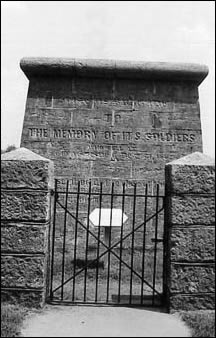
the lieutenant finds an aged, crumbling, grass-encrusted monument to his civil
war brigade, which “in answer to the challenge of this ambitious structure
time had laid his destroying hand upon it, and it would soon be ‘one with
nineveh and tyre’” (308). bierce’s highlighting of the inscription
firmly fixes the narrative thread in two times but only one space, and only further
confirms for the lieutenant the growing suspicion that he is in a different moment
than he believed. with the confirmation comes the realization that the return
to
the
earlier
time
and
his
former consciousness
should not negate awareness of
the present and intervening time, despite the fact he is in the same space (308).
what is not clear is whether or not the man remembers that intervening life.
arguably, he does not. otherwise, why would he be so upset upon realizing he
has grown old? one certainly cannot “experience” life without the
accompanying memory of the activities and events of that life. yet here it is
as
if those event(s) never occurred. for the lieutenant, the shock of understanding
he
is
not who he perceives himself to be is
too much for his elderly constitution. consequently, he “yielded up the
life that had spanned another life” (308).
ambrose bierce is a master of double entendre, innuendo, and mystery. although
his
stories are just plain fun to read, his narratives are much more intriguing as
a focus of serious study. bierce blurs the line of perception in “a resumed
identity.” his readers can only question the reality of the lieutenant’s “life” between
his wounding and his realization that he has effectively lost his entire adult
lifetime.
by anchoring the narrative within the boundaries
of an amnesia episode, bierce also forces his readers to question their own perceptions
of “history” and their place(s) in it. as readers who must by necessity
be in two places at once when reading history or historical fiction, our perception
of where fact ends and fiction begins is always distorted. bierce, along with
other writers who manipulate the chronotope for narrative purposes, call into
question the very nature of existence. his playful
yet skillful handling of the chronotope opens many lines of inquiry. one fruitful
path might be to examine other bierce stories to ascertain any repetition of
the
chronotopic development in “a resumed identity.” another line is
variations on the chronotope, such as in “an occurrence at owl creek bridge” in
which the chronotope involves two spaces contained within one time. “reading” bierce
is a complex task in any context, but bakhtin's ideas provide a practical
means to determining bierce’s narrative strategies. 
online part time jobs from home in sri lankaWorks with Client Service Specialists to obtain and/or validate client information. Updates information in all applicable systems.$500 part time job
work from home for housewife in mumbai
work from home for housewife in mumbai ambrose
bierce, "a resumed identity," phantoms of a blood-stained
period: the complete civil war writings of ambrose bierce,
eds. russell duncan and david j. klooster (boston: university
of
massachusetts
press, 2002), 303. all
citations hereafter cited parenthetically within the text.
work from home for housewife in mumbai mikhail
mikhailovich bakhtin, "forms of time and
the chronotope in the novel," the dialogic imagination,
ed. and trans. michael holquist (austin:
university of texas press, 1981), 243. all
citations hereafter cited parenthetically within the text.
online part time jobs ottawaAverage pay $17.13 per hourpart time jobs for 12th pass students from home
part time jobs for students hamiltonBasic computer skillspart time work from home for students
part time jobs for students hiringRock Solid Reliability � I earn the trust of clients co-workers and fans; I set clear expectations; I deliver high quality work on time and on task; I take the time to do things rightpart time jobs los angeles craigslist
work from home jobs part time no experienceFull-time employees are also eligible for medical dental vision and life insurance with 100% of the premium paid by Boldly.quikr part time jobs work from home
part-time work from home transcriptionBaidu game Qishu answer part-time job introductionwork from home jobs that pay $40 an hour